Before the registers, there was Va
I knew my great-grandmother as Va. Her name in the records is Gladys Fyffe, later Gladys Fyffe Murray. I spent childhood summers with her in St. Mary. My grandmother Lurlene was her daughter, and my mother, Winton Murray, was Lurlene’s daughter. These were people in my life before they became names in my research.
Following Va’s family backward took me to her parents, Daniel Boscoe Fyffe and Albertha Peart, and then to Daniel’s parents, Robert Fyffe and Matilda Kidston. Our family remembers Matilda as Aunt Mattie. Aunt Tilly, the daughter of Va’s sister, remembered her coming to live with the family toward the end of her long life. That recollection brought an ancestor born shortly after emancipation within reach of living family memory. [F1]
At a family reunion we saw a bed that had belonged to Daniel and Albertha. They are buried at Copper in St. Mary. Objects, graves and recollections give this history a physical presence. My family research also identifies Ivan as Daniel’s brother, connecting that branch of the family to the same earlier generations. [F13]
The breakthrough came when the search passed beyond Matilda and her father Joseph into the slave registers. There I could follow the line to Joseph’s mother, Jane, and to Jane’s mother, Marianne. One word beside Marianne’s name carried the family history across the Atlantic: African.
This is the story of that connection, and of what the surviving documents let us recover about the people behind it.
Marianne / Quasheba and her daughter, Abba / Jane
The 1817 return for Mary Roche in the parish of St. Mary is a small list with enormous consequences for our family. It names four people: Edward, Marianne, Maria Davis, and Abba, also called Jane. Marianne is recorded as forty years old and African. Abba alias Jane is twelve and described as Creole, the register’s term for local birth. Beside Jane’s entry is the relationship that makes this page so important: “Marianne her mother.” [F14]
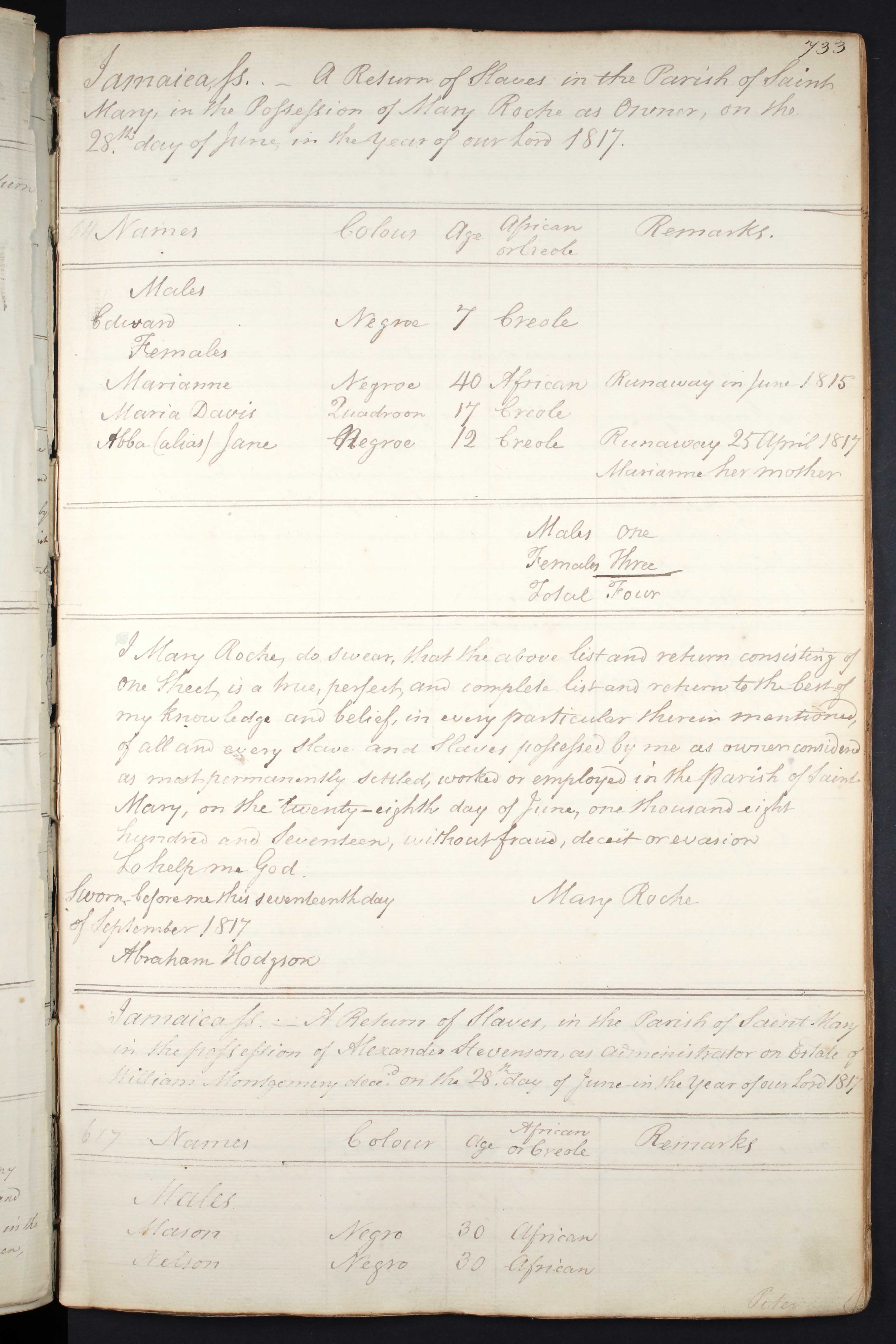
Abba and Jane are not two women on this page. They are two names for the same girl. Earlier family summaries separated them; the image resolves that point directly.
If Marianne’s recorded age was accurate, she was born around 1777. Jane’s age points to a birth around 1805. These are estimates from a register, not exact birthdays. Other ages in the family’s research may produce a wider range, and those differences should be retained rather than forced into a false precision.
Marianne’s African birth and enslavement in Jamaica support the conclusion that she survived forced Atlantic transportation. The page does not identify her country, community, language, ship, arrival date or route. It gives us a named African-born woman and her daughter. That is already a substantial recovery.
The entries that tell us they resisted
Marianne’s entry records an escape in June 1815, two years before this return was compiled. Jane’s records an escape on 25 April 1817, when her stated age was twelve. These are not imagined scenes added to make the history dramatic. The dates appear in the record. [F14]
What the clerk called running away can also be understood as an attempt to escape enslavement. The register gives us the enslaver’s accounting of an absence. It does not give us either woman’s account of her decision, destination, companions or means of survival.
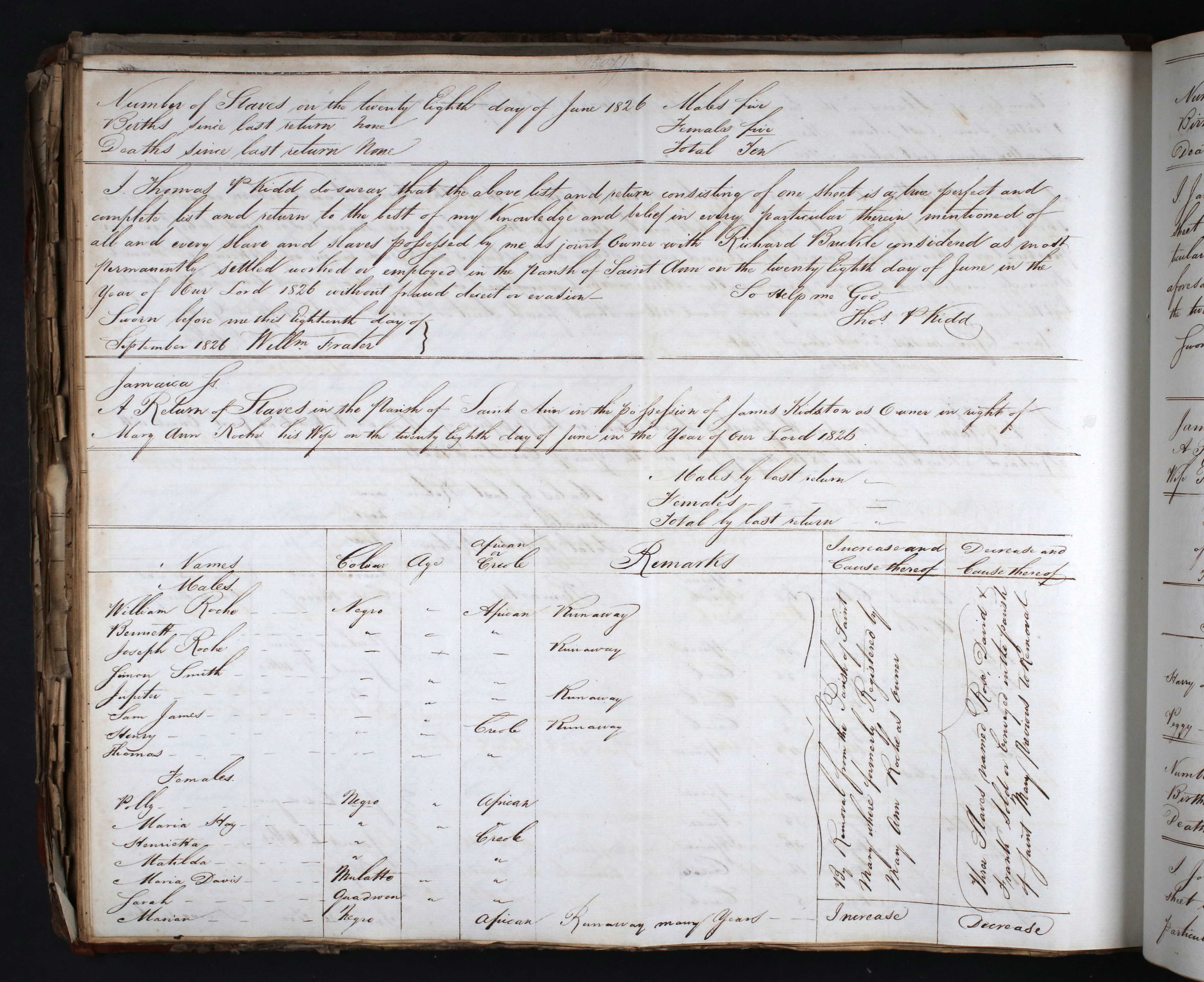
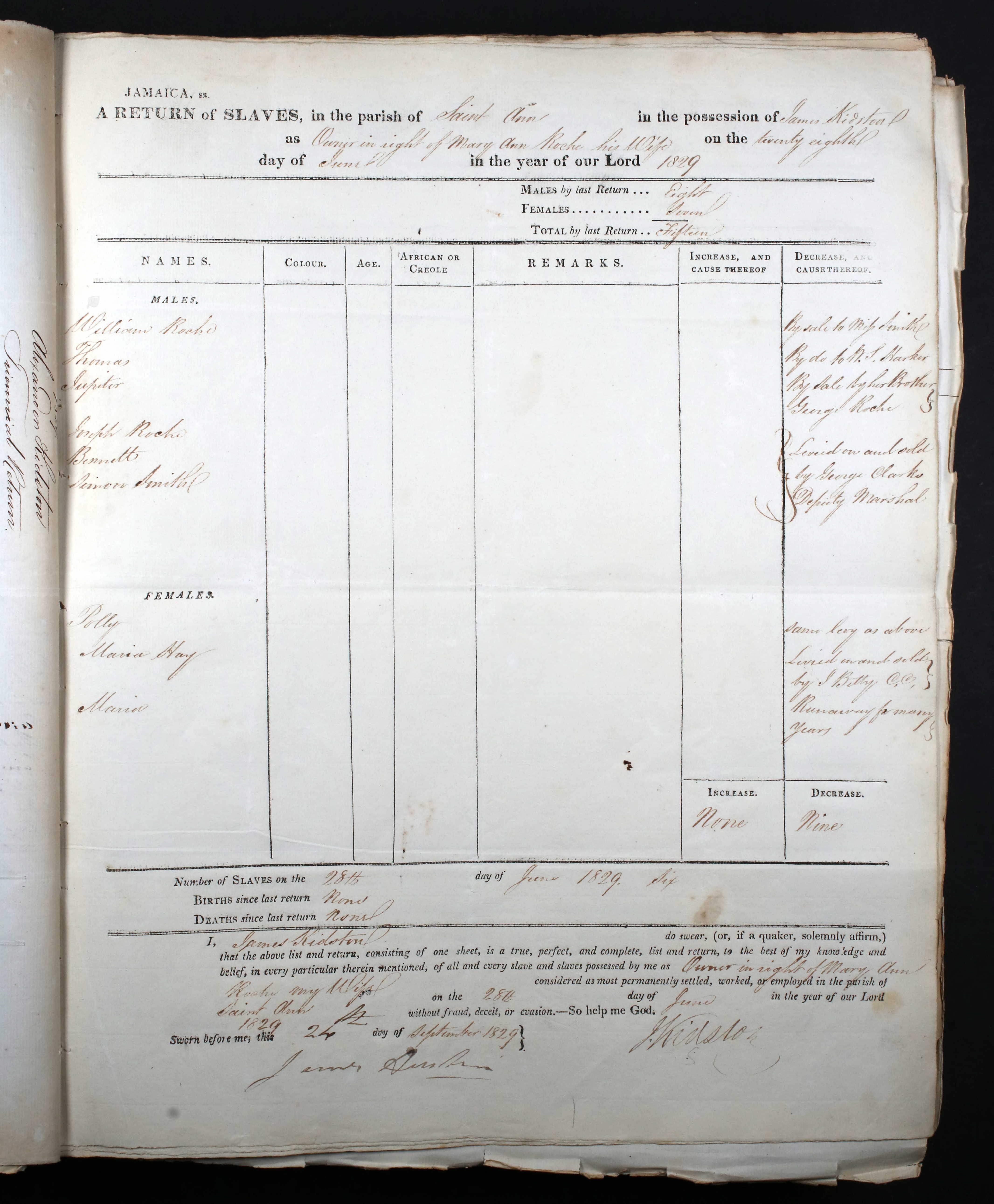
Later entries deepen Marianne’s story. The 1826 page carries a remark reading “Runaway many years” beside her name, and the 1829 return repeats that description. Read alongside the June 1815 date, these entries support a prolonged recorded absence from the enslaver’s control. [F16] [F17]
Our family account has described Marianne as having escaped and never been caught. The pages now reproduced are consistent with a long absence, but they do not establish her ultimate fate. A person could remain in an enslaver’s records as a claim long after the enslaver had lost physical control. Her continuing appearance is not evidence that she was present on an estate.
Nor should Jane’s later place in the family be used to invent the circumstances of her return. My family research follows her into later records and identifies her as Joseph’s mother. The 1817 image itself records her escape; it does not record a capture date or say how she returned. [F13]
The National Archives identifies escape as a common form of resistance and points researchers to newspaper notices. That is an important next route for Marianne and Jane. A securely matched advertisement might add a physical description, an African designation, a place or a named associate. Until such a notice is found, none of those details should be supplied from imagination. [H11]
A sale, a marriage and a change in registration
The 1823 return is headed as a return for Mary Ann Roche in St. Mary. It reports changes since the previous return: Edward’s death and Jane’s sale in 1822. It leaves a recorded total of three females. This is a return of changes, so it does not repeat the names and ages of every person previously listed. [F15]
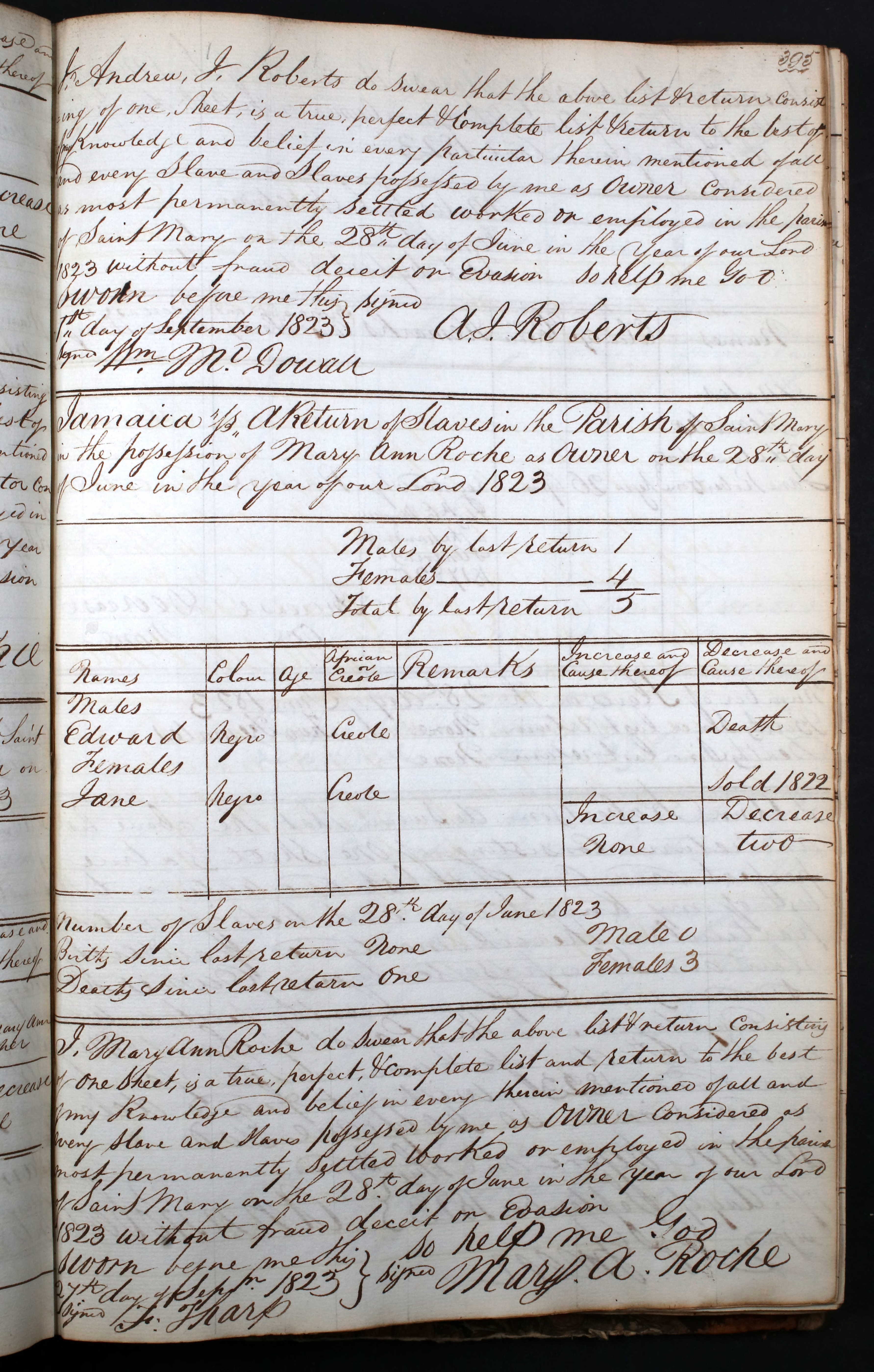
For a family historian, “Sold 1822” is both evidence and an unfinished question. It records the exercise of ownership over Jane, but does not name the purchaser. The receiving return or a transaction record is needed to describe that particular transfer. My established lineage continues through Jane; the circumstances of the sale deserve their own explanation rather than disappearing from the story.
By 1826, the registration is in St. Ann and the legal heading has changed. James Kidston is named as owner “in right of Mary Ann Roche his wife.” The wording documents their marriage within the register itself, even without a separate church marriage entry reproduced here. It also shows how marriage altered the legal administration of the people Mary Ann held in slavery. [F16]
The 1829 return again names James in the same marital capacity and again places the registration in St. Ann. Marianne remains on the page, with “Runaway many years” in the remarks. [F17]
My research subsequently follows the family into registration associated with Alexander Kidston in St. Ann and the Arthur’s Seat connection. The four images reproduced here establish the earlier Roche and James Kidston stages; they do not themselves show that later Alexander entry. [F13]
The geography is consistent with the family becoming established in St. Ann, where Joseph appears in Matilda’s later records. Still, changes in the registering person and parish are not automatically dates of physical movement. We can distinguish three developments: a recorded sale, James’s administration through his wife, and the later Alexander connection. They need not have happened at the same time or through the same transaction.
Joe becomes Joseph Kidston
My verified family research identifies Joe, later Joseph Kidston, as Jane’s son. In the 1826 registry he is recorded as one year old, giving an estimated birth around 1825. The supplied page reproduced above does not include his entry, so that detail is attributed here to the wider register research rather than presented as a transcription of the image. [F13]
Joseph was born into slavery. His early life belongs to the same Roche and Kidston history through which Jane and Marianne have been traced. A child born to an enslaved mother inherited her enslaved status. That rule made a mother’s identity important to the administration of ownership; it also left relationships that descendants can recover from the records.
The family account associates the Kidston surname with that history of enslavement. We should retain the distinction between a child entered as Joe and the man who later appears as Joseph Kidston. The precise date when he began using the surname is not established by the four pages reproduced here. Nor does sharing a surname establish biological descent from an enslaver.
Joseph’s childhood crossed the emancipation boundary. Based on a birth around 1825, he was about nine when abolition with apprenticeship took effect on 1 August 1834, and about thirteen when full emancipation followed on 1 August 1838. These ages are approximate. His daughter Matilda would be born into legal freedom. [H3]
That change was consequential, but freedom did not erase the earlier distribution of land, housing and power. Joseph appears as a labourer when Matilda’s birth was registered. Earlier research summaries described Joseph as a later freeholder or landowner near Gayle. The records reproduced here do not establish that claim, and I do not treat it as a verified finding. They identify him as a labourer at Bogg Pen when Matilda’s birth was registered. Daniel Boscoe Fyffe’s later ownership of land at Farm Pen is supported by documentation in my family research. Whether Daniel or his father Robert originally purchased that land remains an open question; ownership and the first purchase are different claims. [F2] [F13]
Matilda, Catherine and the birth entry
The family archive contains a page saved as “Matilda kidston Baptism.jpg.” Its heading and columns identify a birth register, not a baptism record. Entry 435 records Matilda’s birth on 5 April 1845, naming Joseph Kidston as father and Catherine Kidston as mother. Joseph is described as a labourer; Bogg Pen appears with his informant entry. Registration is dated 24 May. [F2]

Catherine belongs in the story with her own name. Following a single ancestral line can make the other parent disappear from the telling. Here the record places Joseph and Catherine together as Matilda’s parents, in St. Ann, less than seven years after full emancipation.
Matilda’s later death registration records her death at Farm Pen, St. Mary, on 6 May 1947. It gives her age as 103. Louise Fyffe is identified as her daughter, present at the death, and appears as informant. [F5]
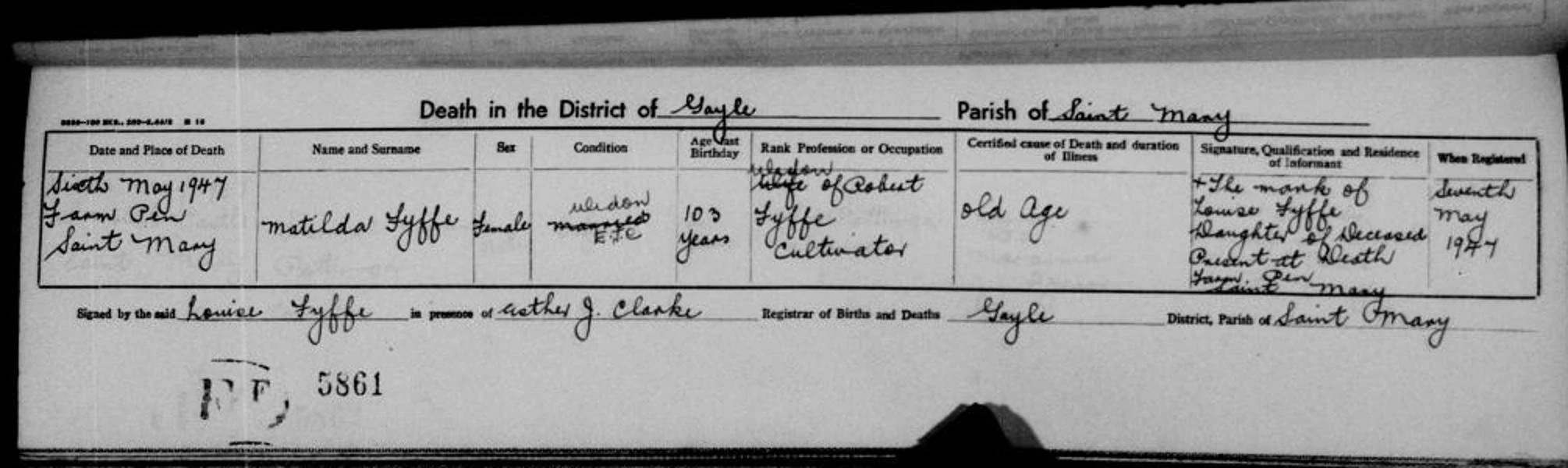
The two records contain an incongruence that should remain visible. A birth on 5 April 1845 and death on 6 May 1947 give an age of 102 years and one month. A reported death age of 103 points to a birth around 1843 or 1844. Ages supplied many decades later can differ from earlier records. The near-birth entry is the stronger basis for the birth date, while the death registration remains the evidence for the age reported at her death.
Whichever age a relative remembered, Matilda lived across an extraordinary span of Jamaican history: from the early years after full emancipation into the twentieth century. Aunt Tilly’s memory of her brings that span into the family’s own experience. We do not need to remove the disagreement to appreciate the life.
Robert, Matilda and a shoemaker’s household
On 10 April 1872, Robert Fyffe and Matilda Kidston married at St. John’s Church, Ocho Rios. The surviving return describes Robert as a bachelor and shoemaker, Matilda as a spinster, and both as of full age. Their entry is numbered 4 on the right-hand page. Robert was Matilda’s husband; their son Daniel belongs to the following generation. [F3]
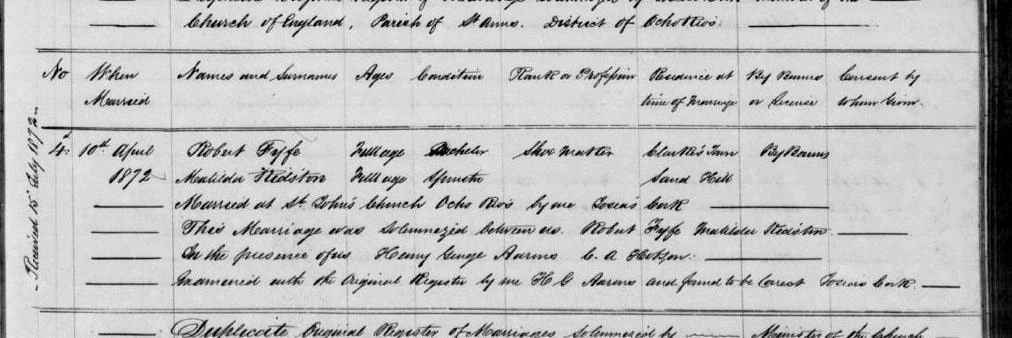
St. John’s gives this event a place that descendants can still recognize. This is the Ocho Rios church in St. Ann, distinct from the church of the same name at Gayle in St. Mary. The Diocese of Jamaica and the Cayman Islands lists St. John’s, Ocho Rios, among its churches. [H14]
For a modern view of St. John’s, see the photograph published by Christobel Travel. The photograph is linked to its publisher.
The National Library of Jamaica also preserves a dated historic photograph of the Ocho Rios church from 1931, catalogue D0009196. It can be viewed through the library’s catalogue. Reproduction requires permission, so the historical photograph is linked rather than copied into this article. [H15]
Robert and Matilda’s household is associated with Clark’s Town in Daniel’s baptism record. That residence belongs in the family’s geography; it should not be converted into an unsupported landownership claim. Robert’s occupation adds substance to the household’s history. Shoemaking was skilled work. The return does not tell us whether he owned a shop, worked from home or served particular customers. It does establish a trade that should remain part of how the family is remembered.
Daniel’s baptism entry records his birth at Clark’s Town on 27 February 1873 and baptism on 5 November 1873. Entry 49 on page 278 names Robert Fyffe and Matilda Kidston as his parents and again identifies Robert as a shoemaker. [F4]

Our family uses Daniel Boscoe Fyffe. Buscoe appears in the saved record names and research notes. Both spellings belong in the search trail. The same principle applies to Fyfe and Fyffe, and to place names whose spelling changes between documents.
The baptism includes a colonial colour classification, reproduced in the image. Such labels reveal how the recording society categorized people. They should not be converted into a precise genetic ancestry calculation or treated as the person’s own identity.
Gladys, known to us as Va
Daniel and Albertha’s daughter Gladys is the Va with whom I spent those childhood summers. Our family identification of her mother is Albertha Peart. The compiled tree also records that relationship. The images reproduced here establish Daniel as Gladys’s named father at marriage, but do not include her own birth registration naming her mother. These are different kinds of evidence, and both can be stated clearly. [F9] [F13]
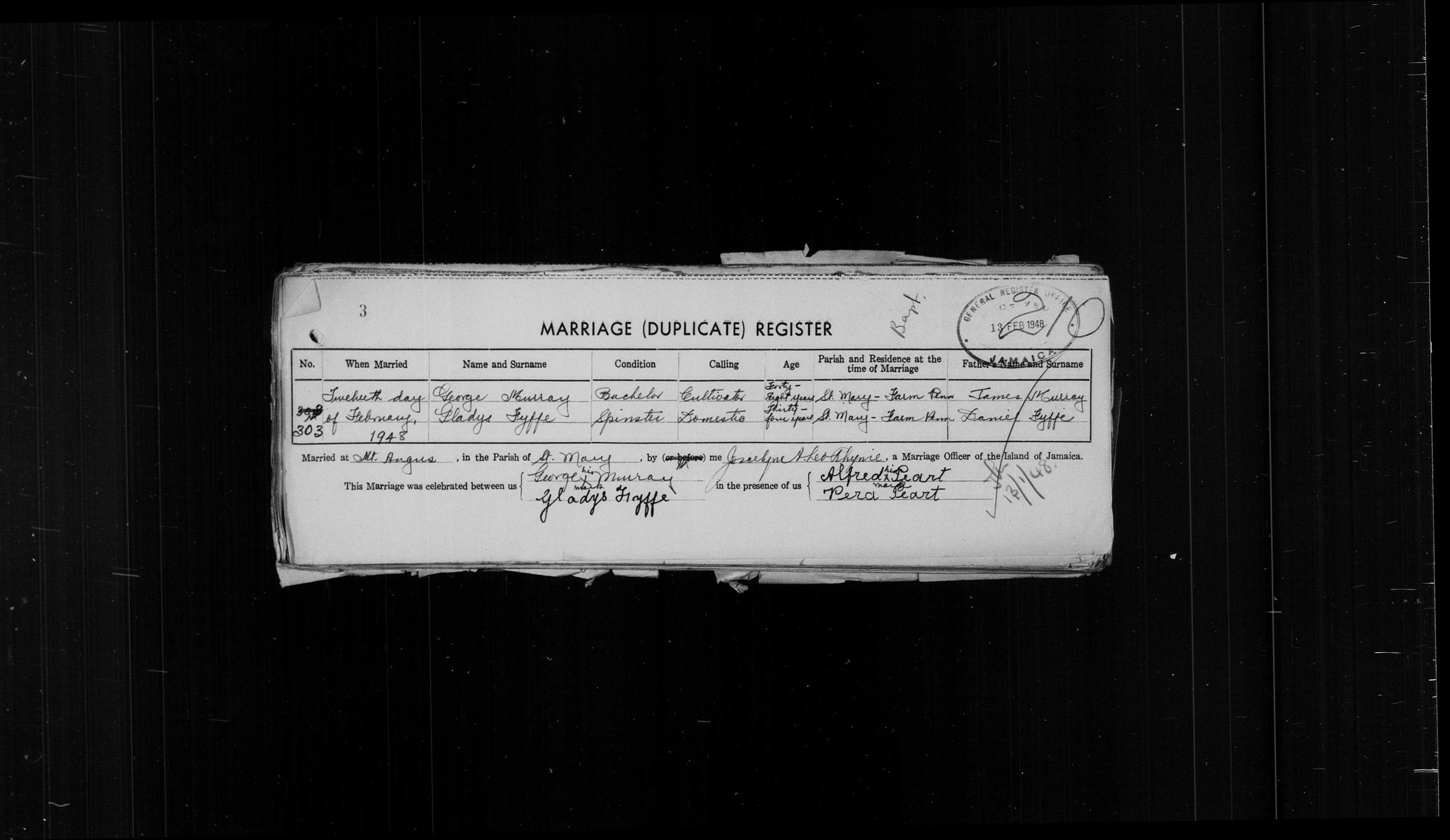
Gladys Fyffe married George Murray on 12 February 1948. Their return associates them with Farm Pen, St. Mary, and names Daniel Fyffe as Gladys’s father and James Murray as George’s father. Va, Gladys Fyffe and Gladys Fyffe Murray are the same person at different points in the family’s speech and records. [F6]
My grandmother Lurlene’s birth registration gives the next direct link. Born at Farm Pen on 15 November 1923, she is recorded as the daughter of Gladys Fyffe, described as a domestic servant. Cecil Williams is the informant, present at the birth. Registration is dated 23 November. [F8]
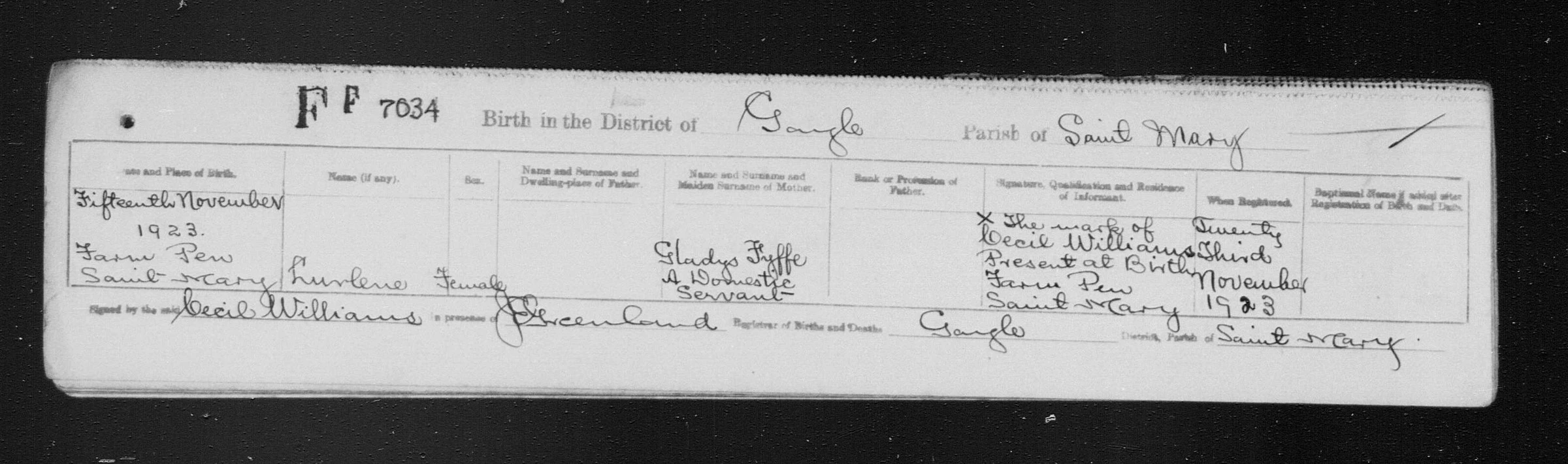
Cecil Williams is Lurlene’s father, as established in our family history. The father’s-name field on this particular registration is blank, while Cecil is identified as informant, present at the birth. The family relationship and the role assigned to him by this document should both be stated accurately.
Va’s work belongs in the history alongside Robert’s shoemaking and Joseph’s labouring. Domestic service is not an incidental detail. It is part of the family’s recorded working life, even though this entry cannot tell us all the circumstances of that work.
Her death registration records 13 November 1977 at the Public Hospital in Port Maria, with Gayle as her usual residence and a reported age of seventy. The age of thirty-nine in the 1948 marriage return implies a somewhat later birth. Both reported ages are retained; neither is turned here into an invented exact birthday. The full death-registration image remains available in the record notes below. [F7]
From Va through Lurlene, then my mother Winton Murray, the line reaches me. The names in the oldest registers are therefore connected to a family I knew, not merely to a chart assembled from distant names.
Arthur’s Seat, Bogg Pen and the Kidston connection
The family’s records connect places across St. Ann and St. Mary: Bogg Pen, Clark’s Town, Ocho Rios, Farm Pen, Gayle, Copper and Port Maria. They represent different kinds of location. A birthplace, a residence, a church, a hospital, a burial place and an estate registration are not interchangeable.
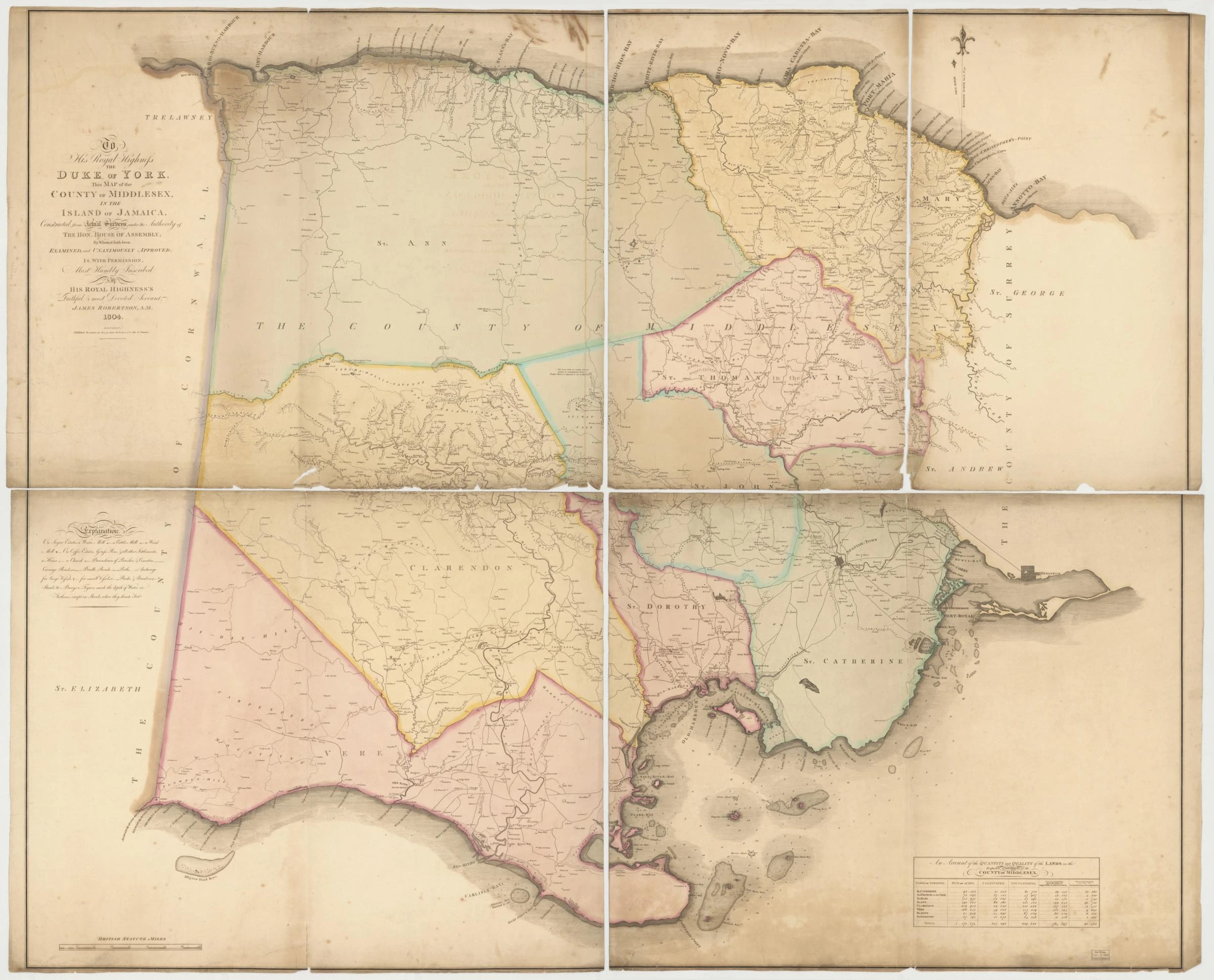
Arthur’s Seat enters through the Alexander Kidston connection in my research. Published almanac transcriptions place Alexander Kidston at Arthur’s Seat under St. Ann in 1812 and 1817. Later St. Ann lists associate him with Bogg and other properties. These are useful estate-history leads, but an almanac entry naming an enslaver does not, on its own, place every member of this family on that estate. [H8] [H9] [H16]
Similar estate names recur in different Jamaican parishes. A present-day photograph of a house called Arthur’s Seat would be misleading without a secure identification. For the same reason, my question about a possible connection between the Roche family and Rochedale near Gayle remains a research lead, not an established explanation of the place name.
The 1829 St. Ann almanac transcription lists Alexander and James Kidston separately. The register images establish James’s connection to Mary Ann through marriage. My family research distinguishes two Alexander Kidstons, father and son, and identifies James and the younger Alexander as brothers. This clarification comes from the family research, not from the shared surname alone; the supporting relationship records are not reproduced in this article. [H9]
These enslaving families matter because they help explain the record trail. They should not become the main characters at the expense of Marianne, Jane, Joseph, Catherine and the generations who followed them.
Quasheba and Abba: a cultural connection to Ghana
Marianne’s day name, Quasheba, and Jane’s day name, Abba, deserve to remain beside their European names. They connect this family story to Akan naming traditions associated with present-day Ghana. In those traditions, a day name links a child to the day of birth. Forms and spellings vary across Akan communities and the diaspora. University of Ghana scholar Kofi Agyekum’s study identifies Aba as the Fante female Thursday name and explains the cultural role of Akan birthday names. [H17]
Abba, written as an alias for Jane in 1817, is a significant cultural clue. Aba and related forms occur within West African day-name traditions and in records of the African diaspora, with an association with Thursday. Quasheba is associated with Sunday in the diaspora naming evidence. Historian Nic Butler documents both forms among day names in slavery-era South Carolina records. This is comparative naming context, not direct proof of Marianne’s birthplace. [H6]
My family research identifies Marianne as Quasheba. That alias is not visible in the four register images reproduced here, so it remains attributed to the wider family research. It should not be presented as something a reader can see on the 1817 page. [F13]
Together, Quasheba and Abba strengthen the cultural connection to the Akan-speaking world and make Ghana an important direction for further research. Names could also survive across languages, generations and communities. A name cannot by itself assign Marianne to a modern country, prove an ethnic identity or establish the day on which Jane was born. It can direct a search toward relevant naming practices while the documentary work continues.
The next discoveries may come from a receiving return for Jane’s 1822 sale, the full 1826 entry identifying Joe and his mother, the later Alexander Kidston registration, land records for Joseph, or a securely matched escape advertisement. Those documents would answer different questions. None should be treated as already found simply because it is a promising next source.
Freedom also needs to be understood beyond its legal date. The National Library of Jamaica describes the coercive apprenticeship system; the Jamaica National Heritage Trust explains how control of land and housing continued to shape labour after emancipation. That context helps us understand why the later history of work, home and land matters. It does not establish a particular experience for an ancestor without a record. [H3] [H5]
What we have recovered is substantial: an African-born woman, her explicitly identified daughter, recorded attempts to escape, a son born enslaved, and descendants who formed households in freedom. Marianne’s life was larger than the return that preserved her name. The remaining gaps are reasons to keep looking.
The chronology and the family line
| Date | Event | Evidence |
|---|---|---|
| About 1777 | Estimated birth of Marianne. | Age forty in the 1817 return; approximate [F14]. |
| About 1805 | Estimated birth of Abba alias Jane. | Age twelve in 1817; approximate [F14]. |
| June 1815 | Marianne’s escape recorded. | Retrospective remark in the 1817 return [F14]. |
| 25 April 1817 | Jane’s escape recorded. | Remark in the 1817 return [F14]. |
| 1822 / 1823 | Jane’s sale in 1822 reported in the 1823 return. | Receiving purchaser not named on this page [F15]. |
| About 1825 | Birth of Joe, later Joseph Kidston. | Family-verified reading of age one in 1826; entry not in the supplied page [F13]. |
| 1826 / 1829 | James Kidston registers in St. Ann in right of Mary Ann Roche, his wife. | Headings reproduced; Marianne recorded as long absent [F16 to F17]. |
| 1834 / 1838 | Abolition with apprenticeship, followed by full emancipation. | Historical context; Joseph’s approximate ages nine and thirteen [H3]. |
| 5 April 1845 | Matilda born to Joseph and Catherine Kidston. | St. Ann birth entry 435 [F2]. |
| 10 April 1872 | Robert Fyffe and Matilda Kidston marry. | St. John’s, Ocho Rios; entry 4 [F3]. |
| 27 February / 5 November 1873 | Daniel’s birth and baptism. | Robert and Matilda named; baptism entry 49 [F4]. |
| 15 November 1923 | Lurlene born at Farm Pen. | Gladys Fyffe named as mother [F8]. |
| 6 May 1947 | Matilda dies at Farm Pen. | Age reported as 103; differs from age calculated from the 1845 entry [F5]. |
| 12 February 1948 | Gladys Fyffe, Va, marries George Murray. | Daniel Fyffe named as her father [F6]. |
| 13 November 1977 | Va dies at Port Maria; usual residence Gayle. | Death registration [F7]. |
Nine people, eight links between parents and children
- Marianne / QuashebaAfrican-born; Quasheba is her day name in the family research; mother of Abba / Jane.
- Abba / JaneAbba is her day name; daughter of Marianne / Quasheba and mother of Joseph.
- Joseph Kidston / JoeBorn about 1825; father of Matilda with Catherine Kidston.
- Matilda Kidston FyffeDaughter of Joseph and Catherine; wife of Robert Fyffe.
- Daniel Boscoe / Buscoe FyffeSon of Robert and Matilda; father of Gladys with Albertha Peart in the family research.
- Gladys Fyffe Murray, “Va”My great-grandmother; mother of Lurlene.
- LurleneMy grandmother; daughter of Va and mother of Winton.
- Winton MurrayMy mother; daughter of Lurlene.
- Anthony DePassNarrator and descendant.
In this sequence, Marianne is my sixth-great-grandmother. Va is Gladys, not an additional person or generation. Catherine, Robert and Albertha are essential ancestors even though the selected vertical line follows their partners through this branch.
Begin with someone you knew
Jamaicans at home and in the diaspora can use the same approach. Begin with someone whose relationship to you is clear. Gather names, nicknames, places and approximate dates. Record who supplied each recollection and whether they witnessed it or heard it from an older relative.
- Link people through events. Work backward through births, marriages, baptisms and deaths. Compare parents, occupations, residences and informants. A matching name alone is not a complete identification.
- Save the whole page. Preserve its heading, neighbouring entries, page number and archive reference. The oath above a return may belong to someone else. A filename may call a birth entry a baptism. Read the form before interpreting a row.
- Keep aliases together. Abba alias Jane is one person on the 1817 page. Search variants such as Joe and Joseph, Buscoe and Boscoe, Fyfe and Fyffe. Record exactly where each spelling appears.
- Follow transactions in both directions. A sale in an outgoing return should prompt a search for the receiving return. Transcribe the remarks and the legal capacity of the registering person, not just the names.
- Separate place, status and date. Registration in St. Ann is not automatically evidence of a move on the date of the return. A marriage date does not establish when a surname began. A person still claimed on a return might be recorded as absent.
- Preserve disagreements. Matilda’s 1845 birth entry and reported death age belong side by side. Mark estimates as estimates. Keep an unresolved question in the notes rather than silently rewriting the evidence.
The Library of Congress Jamaica genealogy guide connects researchers with parish records, enslavement registers, wills and manumission material. The National Archives guide explains the T 71 route. Some digitised collections require a free account or browsing unindexed pages. Free access does not always mean access without a login. [H1] [H12]
For historical places, compare the 1804 Middlesex map with parish records and Jamaican Family Search almanac transcriptions. Ask churches and archives about appointments before travelling. Ask permission before entering private land or photographing people and graves, and confirm accessibility arrangements directly.
The point is to recover lives as well as names: who raised a child, who made a living, who cared for an elderly relative, who tried to escape, and what later generations remembered. The surviving records were created for other purposes. We can read them carefully enough to begin telling our own story.
Family records and research sources
Family archive
- F1 · Supplied family narrative
- From Marianne to Anthony: Eight Generations, family narrative supplied 18 October 2026. Source for childhood summers and Aunt Tilly’s recollection. Early-lineage confirmation, register chronology, Va’s identification as Gladys, family recollections of Daniel and Albertha, and the later Alexander connection supplied by Anthony DePass; see F13. The mother’s name is corrected to Winton Murray from an inconsistent name in the supplied PDF. The illustrated 1845 entry is used for Matilda’s birth date, with the different reported age at death retained.
- F2 · Matilda Kidston birth entry, 1845
- 1845 St. Ann birth register, entry 435: Matilda, born 5 April; parents Joseph and Catherine Kidston; Joseph, labourer, Bogg Pen. Registered 24 May. Family archive: Mother / Daniel Matilda / “Matilda kidston Baptism.jpg.”
- F3 · Robert Fyffe and Matilda Kidston marriage, 1872
- 10 April 1872, St. John’s Church, Ocho Rios; right-hand page 211, entry 4. Robert Fyffe, bachelor and shoemaker; Matilda Kidston, spinster; both of full age. Family archive: Mother / Robert Fyffe. This form has no father-of-bride field.
- F4 · Daniel’s baptism, 1873
- Birth 27 February 1873, Clark’s Town; baptism 5 November, page 278, entry 49. Parents Robert Fyffe and Matilda Kidston; father a shoemaker. Family archive: Mother / Daniel Matilda. Buscoe/Boscoe spelling retained as a research variant.
- F5 · Matilda Fyffe death, 1947
- 6 May 1947, Farm Pen, Gayle district, St. Mary. Matilda’s reported age is 103; Louise Fyffe, daughter, is the informant. Family archive: Mother / Robert Fyffe. The death age differs from the illustrated 1845 birth entry.
- F6 · Gladys Fyffe and George Murray marriage, 1948
- 12 February 1948: Gladys Fyffe and George Murray, residing at Farm Pen, St. Mary. Fathers Daniel Fyffe and James Murray. Family archive: Mother / Va. Gladys’s reported age appears as thirty-nine.
- F7 · Gladys Murray death, 1977
- 13 November 1977, Port Maria, St. Mary; Gladys Murray, usual residence Gayle, reported age 70. Family archive: Mother / Va. Medical details are not discussed in the narrative.
View the full death-registration image
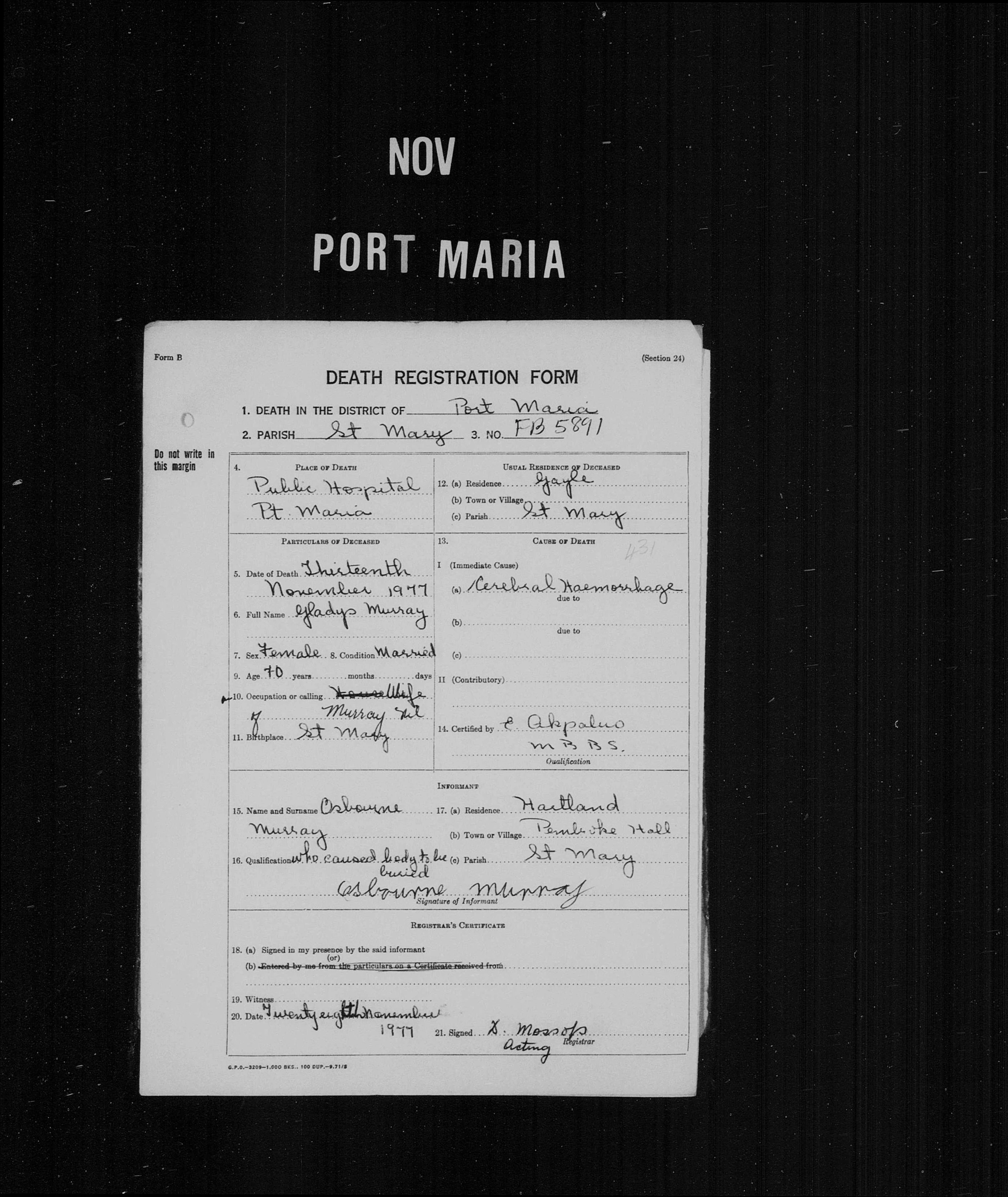
Location: Jamaica; specific locality is identified in the record below. Full family-archive image [F7]. Historical death registration from the family archive. - F8 · Lurlene birth, 1923
- 15 November 1923, Farm Pen, St. Mary: Lurlene’s birth, mother Gladys Fyffe, informant Cecil Williams, present at birth. Registered 23 November. Family archive: Mother / Va.
- F9 · Compiled family tree, June 2024
- Family Tree / “Faily tree 6_2024.jpg.” The screenshot links Daniel Buscoe Fyfe and Albertha Peart, Robert Fyfe and Matilda Kidston, and Joseph and Catherine Kidston. A compiled guide to relationships, not independent verification. Its Matilda dates conflict with the 1845 birth entry.
View the earlier compiled tree
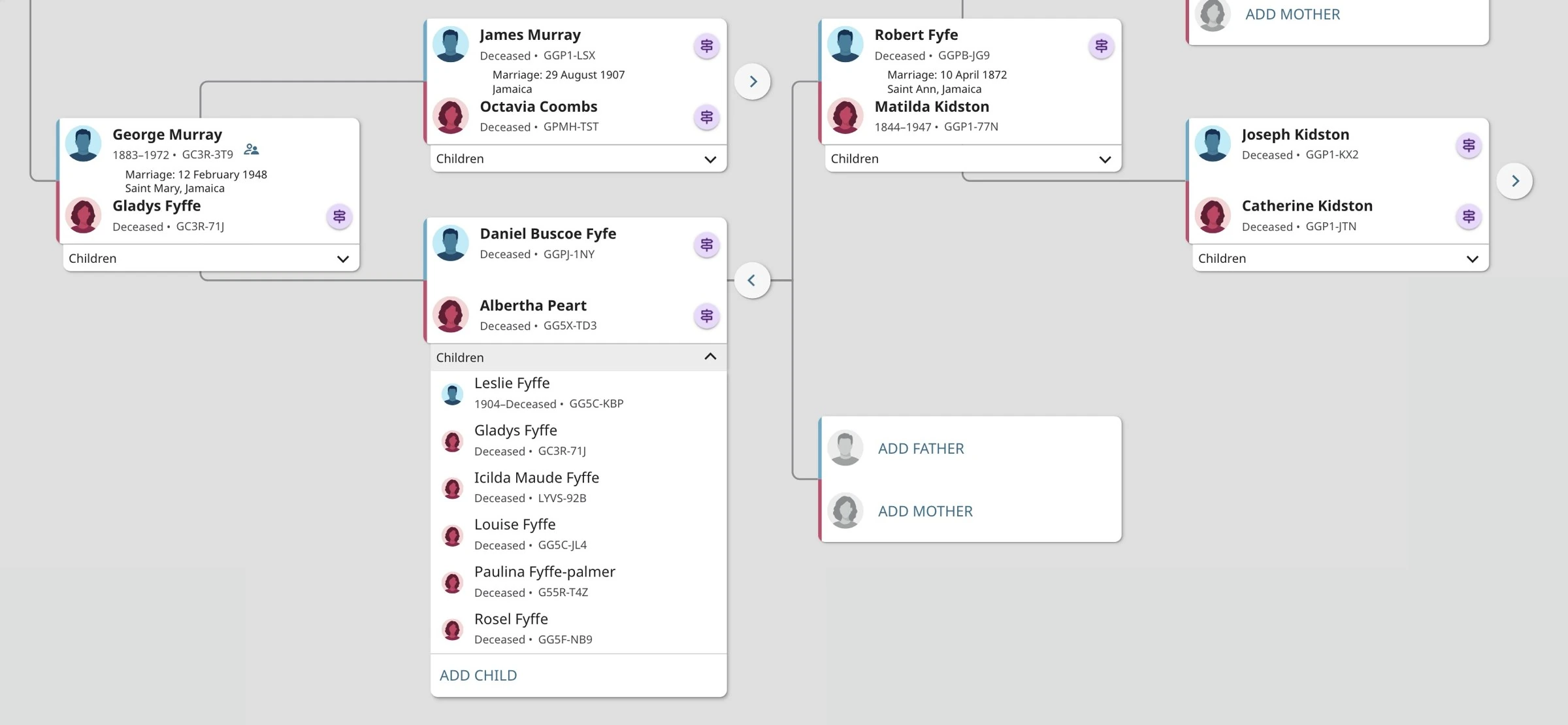
Location: Jamaica; specific locality is identified in the record below. The earlier family tree is a research compilation. Its dates and connections must be compared with originals [F9]. - F10 · Family research and interview notes
- Family research notes, “Robert Fyffe and Matilda Kidston.docx,” and informal notes of a January 2024 conversation with Claudette. Used as attributed research and oral testimony alongside the illustrated life-event records.
- F11 · Port Royal enslavement-register image
- Family Tree / Slavery / “CSUK1817_133624-00706.jpg.” Visible T 71/119; Port Royal, 1817; return involving Jacob DePass as guardian. Examined, but not used to prove the maternal Marianne, Jane, and Joe sequence. Pursue separately for the DePass branch.
- F12 · St. Ann baptism page, 1818
- Family Tree / Mother / “kidstons 1818.jpg.” Kidston children on the left-hand page are described as free children of colour. Examined as contextual evidence; no relationship to Joseph is asserted.
View the baptism page
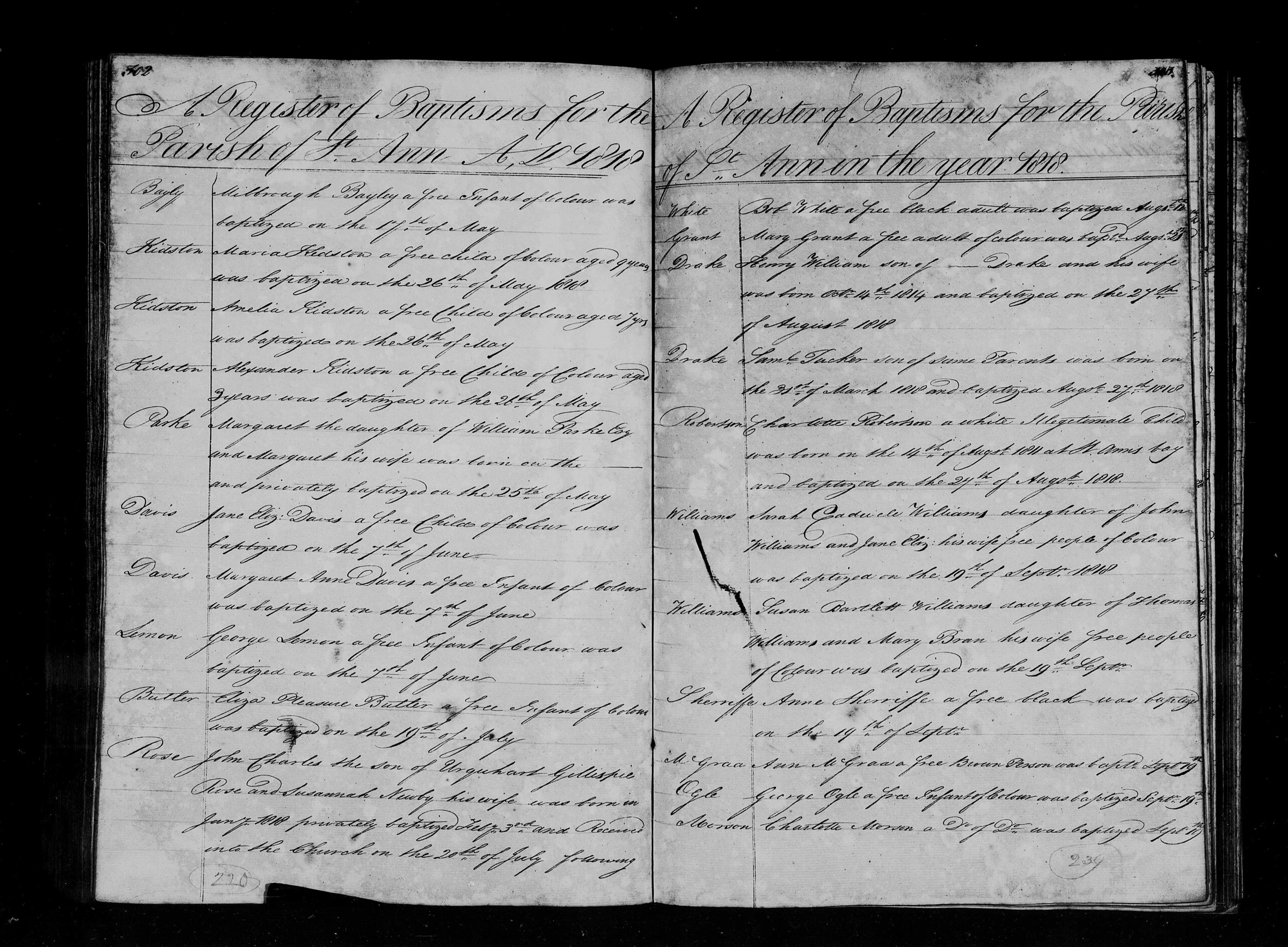
Location: Jamaica; specific locality is identified in the record below. The St. Ann 1818 baptism page contains Kidston entries described as free children of colour. Their relationship to Joseph is not established [F12]. - F13 · Verified family lineage, archival summary and subsequent corrections
- Anthony DePass, Archival Transcription: British Colonial Slave Registers (TNA T 71), supplied 18 October 2026, and his confirmation that he verified all lineage links and Joseph’s consistent appearances in the relevant returns after his birth around 1825. These family research findings are attributed to him; four original register pages are reproduced in this revision, while Joe’s individual entry and the later Alexander return are not among those supplied images. The summary’s broad reference ranges are not substituted for individual folio citations. The inspected 1817 page corrects its treatment of Abba: Abba alias Jane is one person. Quasheba is attributed to the wider research; that name is not visible on the four supplied pages. The summary’s unsupported numerical and spiritual claims are not adopted. Subsequent corrections supplied by Anthony DePass identify Cecil Williams as Lurlene’s father, distinguish the two Alexander Kidstons and the brothers’ relationship, retain Clark’s Town residence, and establish Daniel’s documented Farm Pen landownership. Earlier unsupported claims about Joseph’s landownership are withdrawn. The first purchaser of Daniel’s land has not been established here.
- F14 · Mary Roche’s St. Mary return, 1817
- Return dated 28 June 1817, manuscript page 733. Marianne: forty, African; Abba alias Jane: twelve, Creole; explicit remark “Marianne her mother.” Escape remarks: June 1815 for Marianne, 25 April 1817 for Jane. Family Tree / Slavery / 62711_73022001091_1665-00794.jpg. Original supplied image inspected for this revision. A precise T 71 volume reference is not visible in this image.
- F15 · Mary Ann Roche’s St. Mary return, 1823
- Return dated 28 June 1823, manuscript page 395. Changes: Edward’s death; Jane sold in 1822. The page does not name the purchaser. Family Tree / Slavery / 62711_314054001181_0644-00454.jpg. Original supplied image inspected. The preceding Andrew J. Roberts oath is not Roche’s return.
- F16 · James Kidston’s St. Ann return, 1826
- Lower return dated 28 June 1826. Heading names James Kidston as owner in right of Mary Ann Roche his wife. Marianne’s row records a prolonged absence. Family Tree / Slavery / 62711_314054001181_0640-00535.jpg. Original supplied image inspected. Joe’s entry is not visible in this image. The upper oath belongs to a different return.
- F17 · James Kidston’s St. Ann return, 1829
- Return dated 28 June 1829, again in right of Mary Ann Roche his wife. Marianne appears with “Runaway many years.” Family Tree / Slavery / 62711_314054001181_0646-00078.jpg. Original supplied image inspected. It does not establish her ultimate fate.
- F18 · Kidston portrait
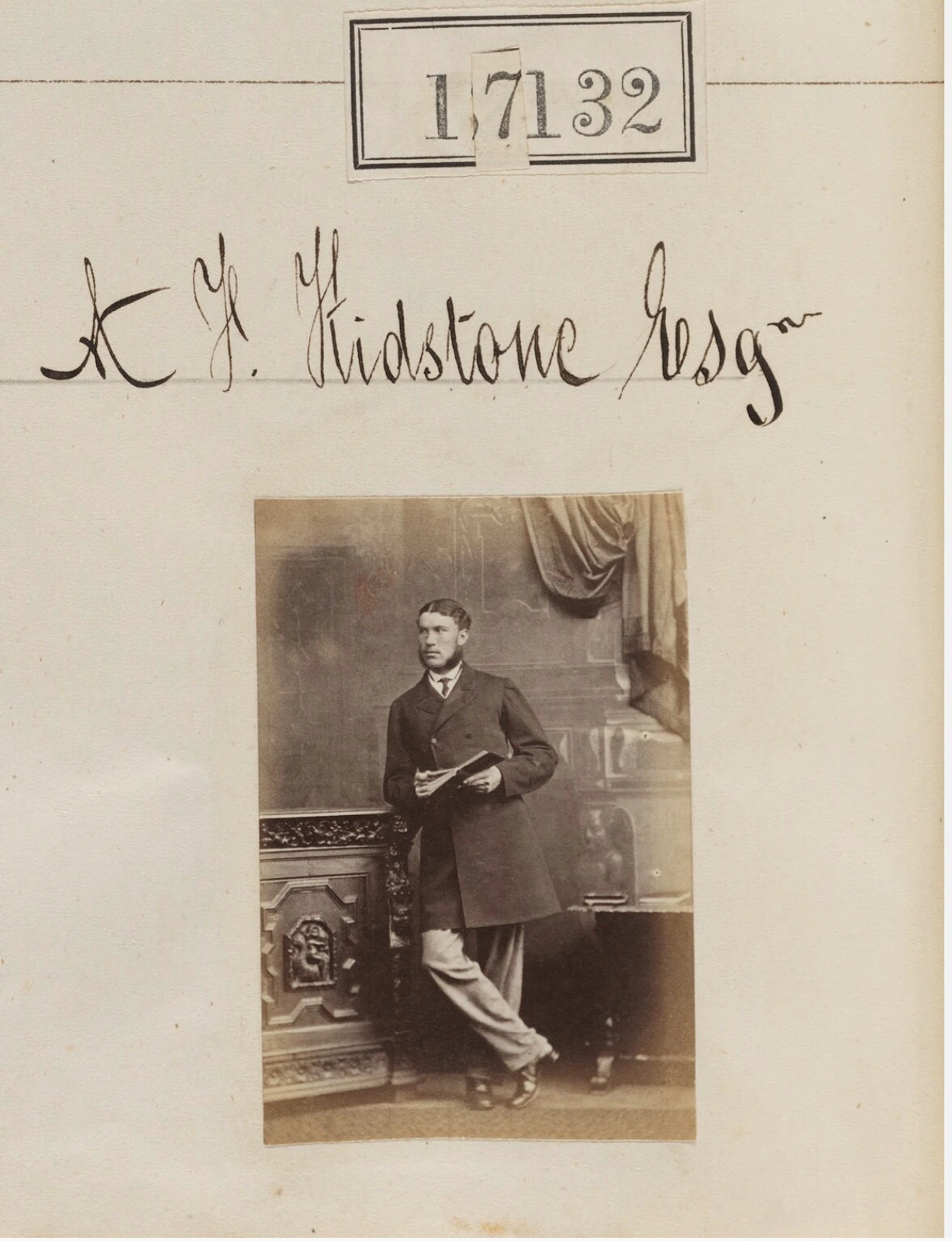
- Family Tree / Kidston.jpg. Identified by Anthony DePass as Alexander Kidston; mount labelled “A. J. Kidstone Esq.” Date, photographer and precise identification relative to the early nineteenth-century estate holder remain unestablished. Reproduced as a family-archive image, not proof of the enslaver’s appearance.
Historical context and research routes
- H1. The National Archives. Enslaved people and slave owners. Guide to registers, fields and T 71.
- H2. The National Archives. Spotlight on slavery registers: transcript. Explains register construction, changes and offensive historical terminology.
- H3. National Library of Jamaica. History Notes, emancipation section. Dates and broad apprenticeship context.
- H4. Williams, James. A Narrative of Events, since the First of August, 1834, by James Williams, an Apprenticed Labourer in Jamaica. Diana Paton, editor. Duke University Press, 2001. Publisher’s description consulted; this research did not examine the full edition.
- H5. Jamaica National Heritage Trust. Free Villages. Land, housing and labour after emancipation.
- H6. Butler, Nic. Charleston County Public Library. Recall Their Names: The Personal Identity of Enslaved South Carolinians. Comparative Atlantic naming context, not direct evidence about this Jamaican family.
- H7. 1825 Jamaica Almanac, St. Mary, returns for March quarter 1824. Jamaican Family Search transcription. Original almanac scan not inspected.
- H8. 1827 Jamaica Almanac, St. Ann, returns for March quarter 1826. Jamaican Family Search transcription. Original almanac scan not inspected.
- H9. 1829 Jamaica Almanac, St. Ann. Jamaican Family Search transcription. Original almanac scan not inspected.
- H10. Jamaica Information Service. Parish Profile: St. Mary. Search-index text consulted; direct page retrieval returned an access error during this review.
- H11. The National Archives. Slavery and the British transatlantic slave trade. Rebellion and resistance context; no family participation established.
- H12. Library of Congress. Jamaica: Genealogy Resource Guide, Archival Records. Collections, unindexed records and access conditions.
- H13. Robertson, James, cartographer and publisher; Samuel John Neele, engraver. This map of the county of Middlesex, in the island of Jamaica. London, 1804. Library of Congress digital image; call number G4963.M5G46 1804 .R6. Catalogue metadata and image retrieved directly. Historical map used for regional context; no ancestral home is plotted.
- H14. Diocese of Jamaica and the Cayman Islands: Churches by Deanery. Identifies St. John’s, Ocho Rios.
- H15. National Library of Jamaica, Church, Ocho Rios, D0009196. 1931 photograph; reproduction requires permission.
- H16. Jamaican Family Search transcriptions of the 1812 almanac and 1817 almanac. Kidston’s Arthur’s Seat appears under St. Ann. Original almanac scans were not examined in this pass.
- H17. Agyekum, Kofi. (2006). The Sociolinguistic of Akan Personal Names. Nordic Journal of African Studies, 15(2), 206 to 235. University of Ghana researcher; see birthday names, pp. 213 to 214, including Fante Aba for Thursday. Open-access article. Consulted for this revision.