Framework / Research & practice

Career Development
Intelligence

Understanding how people imagine a future, investigate possibilities, develop the capacity to choose, and pursue educational and career pathways.

The questionSix domainsAlignmentEvidenceIn practiceResearch agenda

Research, evaluation & human development

What happens between
an aspiration and an outcome?

A career decision takes shape through experiences. People imagine a future, encounter possibilities, question assumptions, develop confidence, and revise their plans. Their circumstances and opportunities shape what they can pursue.

My work in education, program evaluation, and Lifestyle Learning brings me back to a practical question: how can we understand that process well enough to support it?

Career Development Intelligence (CDI) provides a framework for organizing and interpreting the evidence that career development produces. It connects six related domains: Aspirational, Exploration, Developmental, Decision, Alignment, and Outcome Intelligence.

The aim is to understand how those parts of a person’s experience relate. An assessment result, a history of occupations explored, a learner’s explanation, and a later educational outcome each contribute something different. CDI gives practitioners and researchers a structure for considering them together.

The measurement problem

Participation tells us
only part of the story.

Institutions can often count completed assessments, advising appointments, page views, or plans created. They may also know whether someone enrolled, earned a credential, or entered employment. The developmental work between those observations can remain difficult to see.

Two learners can complete the same activity for different reasons. One may discover an unfamiliar occupation. Another may confirm an existing preference. A third may recognize that a desired pathway requires preparation they had not considered. A completion count records participation while leaving those differences unexplained.

CDI treats these differences as questions for investigation. What was explored? What did the learner say changed? What evidence supports that account? What remains unknown? The framework helps connect records that might otherwise sit in separate reports, systems, or conversations.

The framework

Six domains.
One connected inquiry.

The domains organize different kinds of career-development evidence. They can overlap and recur throughout a person’s life. Someone may revisit aspirations after entering a program, return to exploration during a career transition, or reconsider a decision after encountering a new opportunity.

They describe related areas of inquiry rather than a required sequence or a ladder of personal maturity.

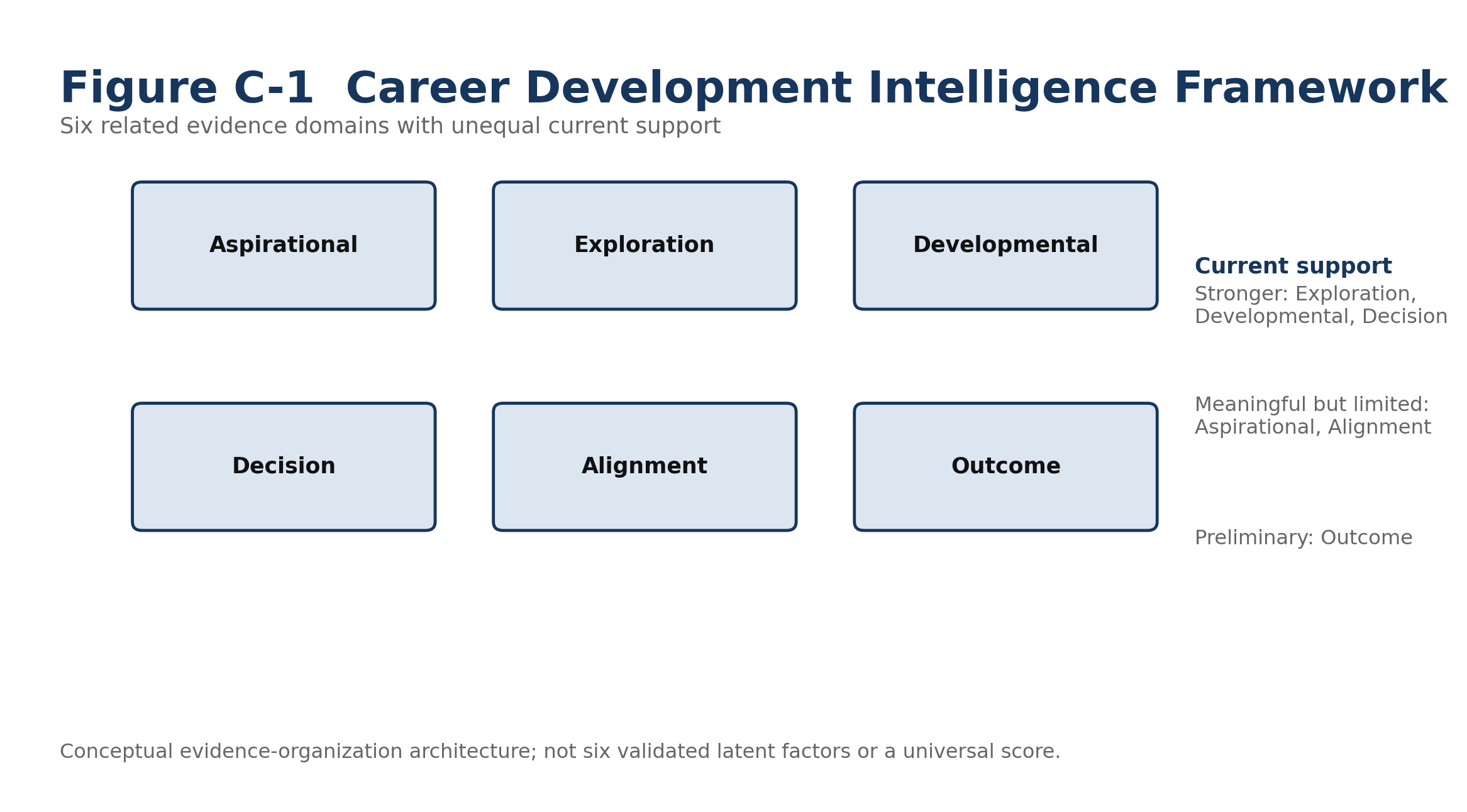
Six related CDI domains: Aspirational, Exploration, Developmental, Decision, Alignment, and Outcome. The figure distinguishes unequal current evidence support across the domains.

The six CDI domains

Aspirational

The future a person hopes to create.

Exploration

How they investigate possibilities.

Developmental

Their preparation and capacity to navigate choices.

Decision

How preferences and commitments take shape.

Alignment

Relationships among goals, pathways, and context.

Outcome

What happens as pathways are pursued.

Six related areas of inquiry, with unequal current evidence support. They are not a sequence or a universal score.

Original figure available at full resolution
The six-domain framework. Original CDI whitepaper figure C-1. Exploration, Developmental, and Decision evidence currently have stronger support. Aspirational and Alignment evidence are more limited, while Outcome evidence is preliminary. Open full-size figure

Domain 1: Aspirational Intelligence

What future does this person hope to create?

Aspirations include desired living conditions, economic expectations, family responsibilities, personal priorities, and future goals. They help explain why a pathway matters to someone and what they hope education or work will make possible.

Career Navideer’s Lifestyle Survey offers one way to observe these preferences. Its Lifestyle Index estimates the annual income associated with selected lifestyle choices. That estimate provides context for a conversation about goals and preparation. A higher index does not indicate stronger motivation or greater readiness.

Possible evidence: lifestyle selections, stated priorities, desired locations, economic expectations, and descriptions of a hoped-for future.

Domain 2: Exploration Intelligence

How is the person investigating possibilities?

Exploration includes searching for occupations, comparing alternatives, examining educational requirements, and returning to questions as understanding develops. Its breadth, depth, and pattern can provide useful context for advising and research.

A record that an occupation page was opened establishes an observed action. A learner’s report of discovering a new career supplies a different kind of evidence. Reading those records together can support a more specific interpretation while keeping the distinction between activity and learning visible.

Possible evidence: occupations explored, resources consulted, comparison activity, repeated visits, and learner accounts of discovery.

Domain 3: Developmental Intelligence

How is the person becoming prepared to navigate choices?

This domain concerns confidence, self-awareness, identity, adaptability, readiness, and the capabilities involved in making and pursuing career decisions. It asks how these capacities develop and what may support or constrain them.

Participation can make developmental activity observable. Establishing growth requires appropriate measures and observations over time. Career self-efficacy provides a useful connection to established research: a person’s confidence in their ability to appraise themselves, gather occupational information, select goals, plan, and solve problems.

Possible evidence: validated confidence measures, reflective accounts, readiness assessments, and repeated observations of relevant capabilities.

Domain 4: Decision Intelligence

How do possibilities become choices and commitments?

Career decisions emerge through comparison, refinement, uncertainty, and revision. CDI examines how preferences become more specific, how people investigate a pathway, and what they say about the reasons for a choice.

Changing a career preference can reflect productive exploration. Retaining a preference can reflect informed commitment. Either interpretation needs supporting context. A selected occupation alone cannot establish the quality, permanence, or eventual implementation of a decision.

Possible evidence: preference changes, pathway investigations, stated decision clarity, commitments, and documented next steps.

Domain 5: Alignment Intelligence

How do the parts of the plan relate?

Alignment brings the domains into conversation. It examines relationships among desired futures, explored occupations, preparation, decisions, available pathways, and the conditions surrounding a person’s choices.

A learner may value staying close to family while considering a program offered far away. Another may discover that an occupation’s earnings differ from the income associated with their selected lifestyle. These tensions can open useful questions about options, tradeoffs, support, and revised plans.

Possible evidence: comparisons across goals, program requirements, costs, occupational information, personal priorities, and opportunity constraints.

Domain 6: Outcome Intelligence

What happens as people pursue their pathways?

Outcomes may include educational enrollment, credential attainment, workforce participation, occupational placement, and later changes in work or life circumstances. They help researchers examine how earlier experiences relate to what eventually occurs.

Immediate feedback, completion of a platform activity, and later employment are different observations. CDI keeps those distinctions explicit. Understanding lasting outcomes requires follow-up records, appropriate comparison designs, and attention to the many influences beyond a particular program or tool.

Possible evidence: verified education and workforce records, documented attainment, and longitudinal follow-up with a defined population.

A connection to established theory

Confidence in the work
of making a career decision.

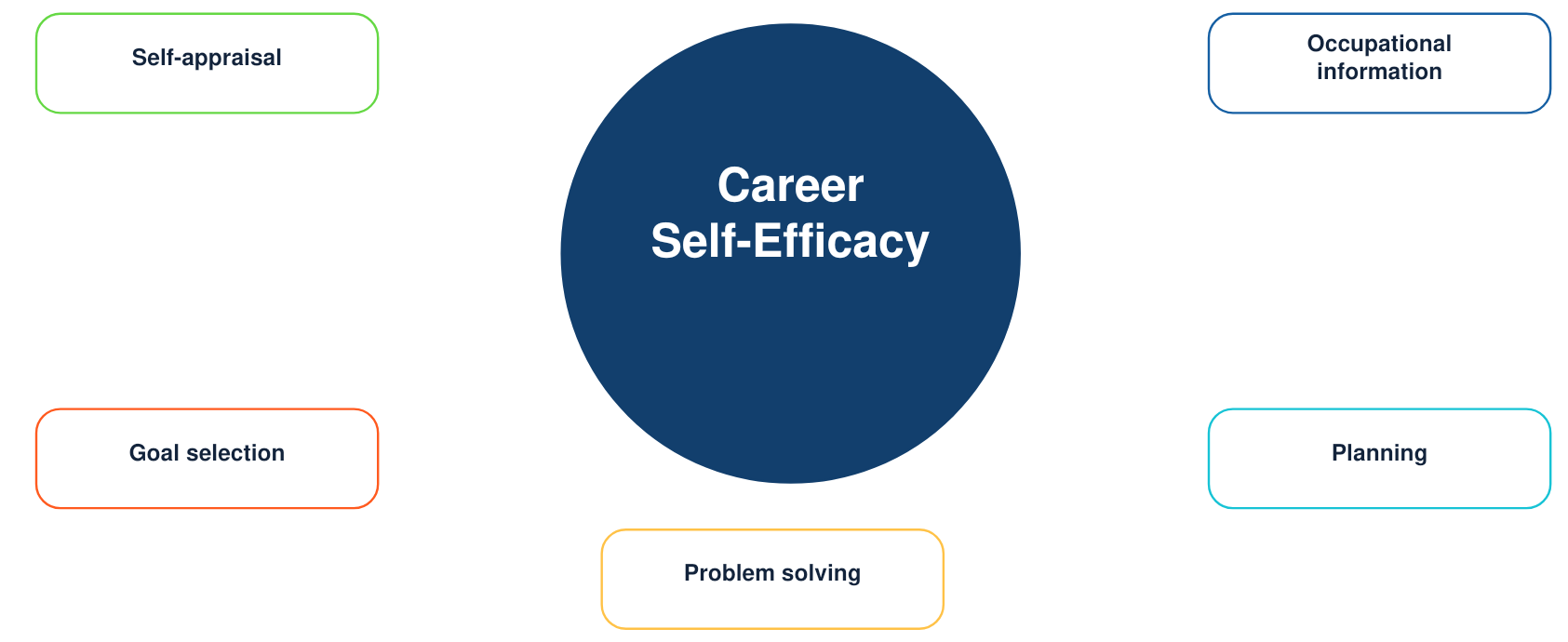
The presentation figure below highlights five areas associated with career decision-making self-efficacy. They help make the developmental question concrete. Can someone assess their interests and capabilities, find useful information, choose a goal, plan a route, and respond when that route becomes difficult?

CDI places evidence about these capabilities within a wider account of aspirations, exploration, decisions, context, and outcomes. Established measures can contribute to that inquiry. Observed platform activity and a validated measure of confidence should retain their separate meanings.

Career self-efficacy surrounded by self-appraisal, occupational information, goal selection, planning, and problem solving.

Career decision-making self-efficacy

Career decision-making confidence

  • Self-appraisal
  • Occupational information
  • Goal selection
  • Planning
  • Problem solving
Original figure available at full resolution
Career self-efficacy. Figure excerpt from the Career Navideer Strategic Collaboration presentation, slide 4. The five areas describe capabilities that can be investigated with appropriate measures. Open full-size figure

The integrative role of Alignment

Coherence, tension,
and missing evidence.

Alignment is central to CDI because the meaning of one observation often depends on another. A stated goal gains context when considered alongside exploration and preparation. A pathway choice becomes more understandable when personal responsibilities and available opportunities are visible.

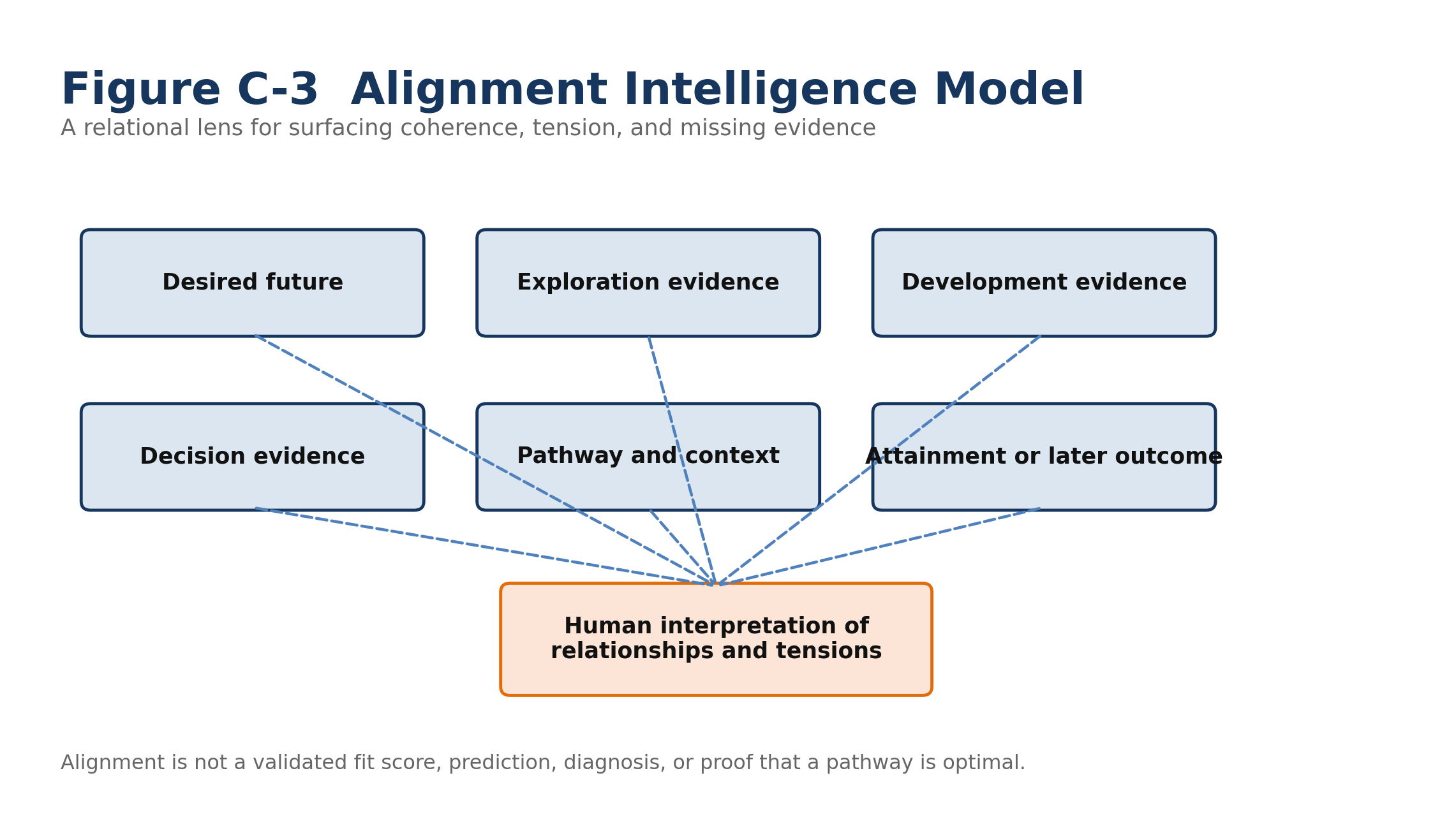
The framework uses several alignment lenses. Aspirational alignment considers desired futures and selected opportunities. Pathway alignment examines how a route connects with a destination. Developmental alignment considers preparation in relation to demands. Economic alignment brings lifestyle expectations and occupational economics into view. Outcome alignment asks how later experiences relate to earlier intentions.

These lenses support interpretation. They do not produce a validated person-career fit score or identify a single optimal future. The useful result may be a better question, a clearer account of a tension, or a recognition that essential evidence is missing.

Desired future, exploration, development, decisions, pathway and context, and attainment or later outcomes connect to human interpretation of relationships and tensions.

Alignment Intelligence

  • Desired future
  • Exploration evidence
  • Development evidence
  • Decision evidence
  • Pathway and context
  • Attainment or later outcome

Human interpretation of relationships and tensions

The connections identify questions for review. They do not establish a validated fit score or a prediction.

Original figure available at full resolution
Alignment as interpretation. Original CDI whitepaper figure C-3. The relationships identify areas for inquiry and human judgment. Open full-size figure

Evidence that can be interpreted together

Keep the observation
connected to its meaning.

CDI distinguishes raw observations, organized information, analysis, and intelligence. Intelligence emerges when patterns are interpreted within a career-development context, with enough attention to uncertainty to support a responsible decision or a useful next question.

Different evidence sources answer different questions. Combining them is valuable when their identities and limitations remain visible.

Evidence layers and the questions they support
EvidenceWhat it can showWhat interpretation still needs
BehaviorRecorded exploration, sessions, comparisons, or pathway actions.Context about access, exposure, purpose, and what the person understood.
Structured self-reportA person’s response to a defined question or measure.Clear wording, an appropriate denominator, and evidence that the measure suits the use.
NarrativeHow a person explains discovery, uncertainty, priorities, or a decision.A transparent interpretation method and attention to alternative readings.
Context and attainmentImplementation conditions, opportunities, completion, and documented milestones.Separation of participation and attainment from claims of lasting benefit.
Later outcomesVerified education, work, or life outcomes over a specified period.Follow-up design, linkage quality, relevant comparisons, and attention to other influences.

The unit of observation matters. A session, a survey response, a narrative comment, and a distinct person are different units. A linked analysis should state which records belong together, how the linkage was made, and which population the result describes. Repeated responses from one person cannot silently become multiple independent people.

A missing record also needs interpretation. A person without a completed Lifestyle Survey may have entered through occupation search, lacked the opportunity to finish, or used the system for a different purpose. Absence of an observation does not establish absence of aspiration or readiness.

Career Navideer as an evidence-generating environment

A framework and
a practical place to study it.

Career Navideer creates opportunities to observe lifestyle selections, occupational exploration, educational investigation, and planning activity within one environment. CDI offers a way to examine relationships among those observations and the accounts people give of their experiences.

The two have distinct roles. Career Navideer is a product and a current source of empirical examples. CDI is a conceptual framework intended to support inquiry across settings. Its usefulness outside Career Navideer remains a question for further research and independent application.

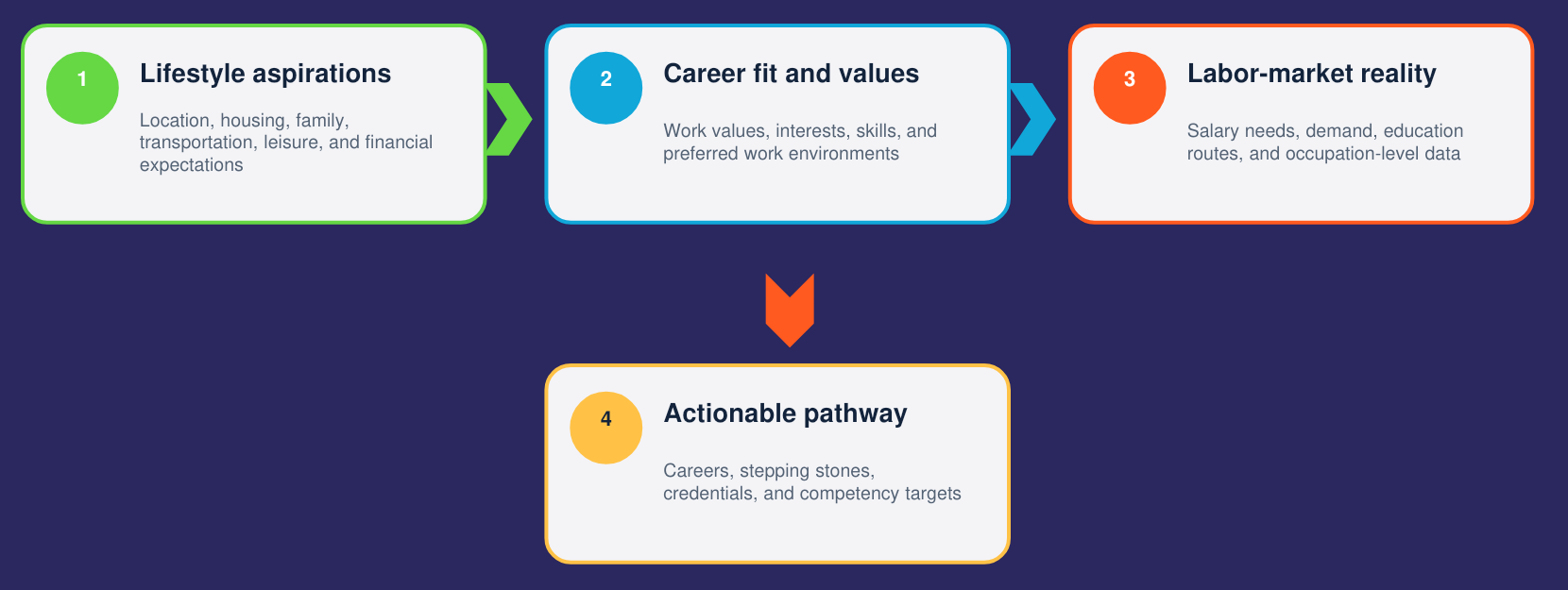
The Career Navideer product model connects lifestyle aspirations, career interests and values, labor-market information, and actionable pathways.

The Career Navideer product model

  1. Lifestyle aspirations

    Location, housing, family, transportation, leisure, and financial expectations.

  2. Career interests and values

    Work values, interests, skills, and preferred work environments.

  3. Labor-market information

    Salary needs, demand, education routes, and occupation data.

  4. Actionable pathway

    Careers, stepping stones, credentials, and competency targets.

A readable adaptation of the intended product workflow shown in the presentation.

Original figure available at full resolution
The Career Navideer product model. Figure excerpt from the Strategic Collaboration presentation, slide 5. It describes the intended product workflow. CDI provides a framework for examining the evidence generated through such an experience. Open full-size figure

An illustrative advising conversation

What would we need to understand this learner’s decision?

Consider a learner who wants to remain near family, explores several healthcare occupations, and begins comparing local training programs. Their activity shows what they investigated. A survey response may indicate that they discovered options they had not considered. A written reflection may explain that program cost or travel time changed their preference.

CDI helps organize the questions. What future matters to this learner? How widely did they explore? What preparation does the preferred route require? What tension exists between the plan and their circumstances? What would we need to follow up to know whether the plan became a completed credential or a job?

This is a hypothetical example of interpretation. The value lies in connecting evidence to a more informed conversation while preserving the learner’s authority over their choices.

Potential uses in institutions
and career-development programs.

Schools and colleges can use the framework to specify what they want to understand about exploration, preparation, advising, and pathway choice. It can help an evaluation distinguish an activity completed from a capability measured or a later outcome verified.

Workforce programs can organize evidence about goals, existing experience, exploration, training options, and transitions. Adult learners’ responsibilities and routes through a tool may differ from those of school-age learners. Interpretation should reflect those differences.

Researchers and funders can use CDI to identify gaps in an evidence plan. Which domains are represented? What is measured directly? Which proposed relationships require follow-up? What comparison would make a conclusion more defensible? These are potential applications whose usefulness should itself be evaluated.

The CDI Intelligence Cycle

Interpretation leads to
a question about action.

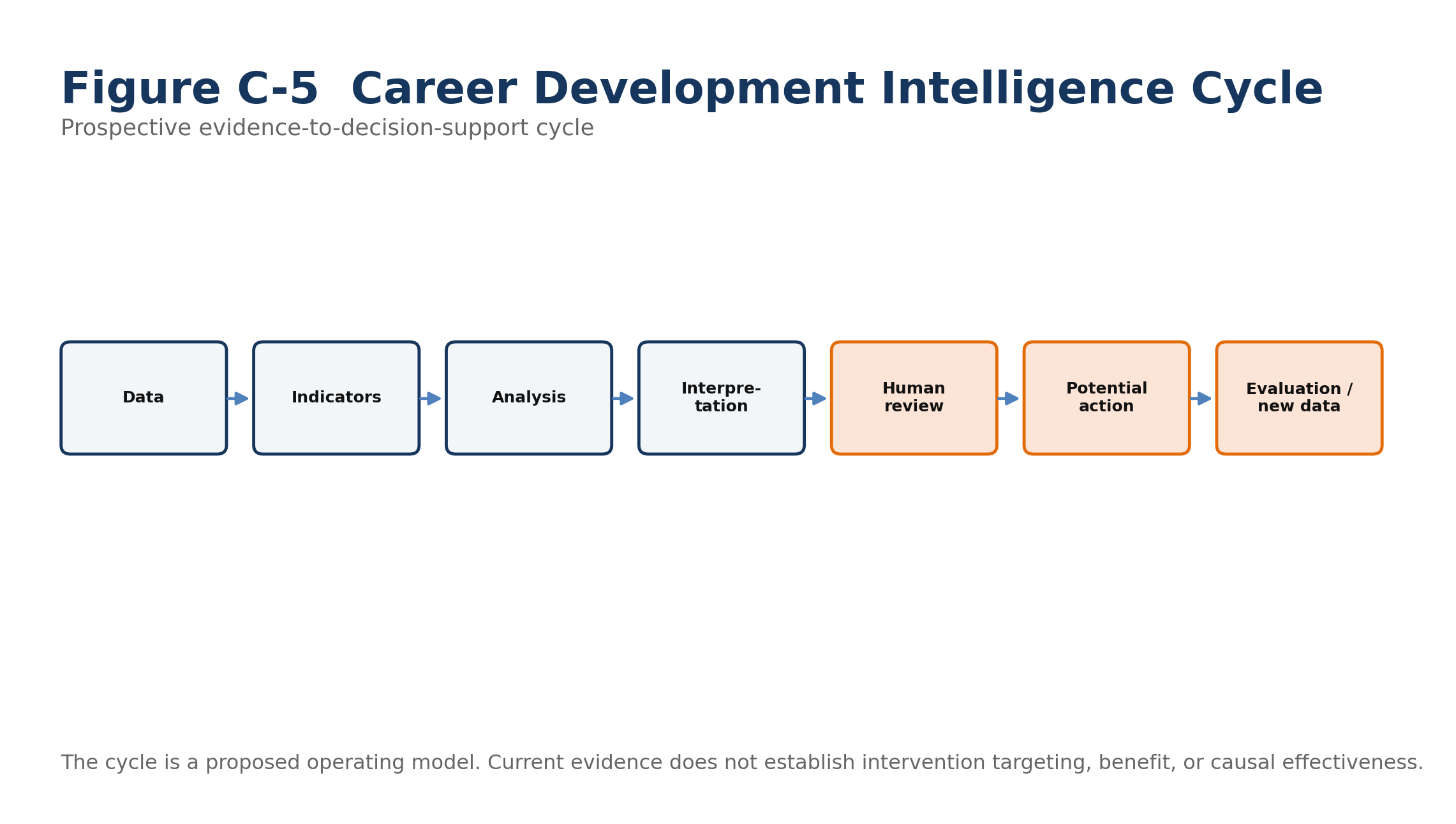
The proposed cycle separates data, indicators, analysis, interpretation, human review, possible action, and evaluation. Each step has a distinct responsibility. An association may justify further inquiry. A possible response requires judgment about context and feasibility. Its effects require their own evaluation.

This creates room for learning from implementation. An institution can document why it changed an advising practice, what happened afterward, and what evidence would support retaining or revising the change. The cycle describes a prospective way of working rather than an established claim that a particular action will succeed.

Data, indicators, analysis, interpretation, human review, potential action, and evaluation or new data form a proposed cycle for evidence and decision support.

The CDI Intelligence Cycle

  1. Data
  2. Indicators
  3. Analysis
  4. Interpretation
  5. Human review
  6. Potential action
  7. Evaluation and new data

A proposed cycle. Any action and its effects require separate evaluation.

Original figure available at full resolution
A proposed cycle for evidence and decision support. Original CDI whitepaper figure C-5. Evaluation and new observations provide the basis for revisiting an interpretation or action. Open full-size figure

Current position & research agenda

A framework to examine,
test, and improve.

CDI’s current contribution is an architecture for organizing evidence and interpreting relationships. Its six domains provide a conceptual structure. Current Career Navideer analyses offer bounded examples of observability and linkage, with stronger support for Exploration, Developmental, and Decision evidence than for some other domains.

This work does not establish six validated factors, one validated CDI score, a person-career fit diagnosis, or proof of long-term educational or workforce impact. Developmental improvement, prediction, and causal effectiveness require additional research designs and independent evidence.

The research agenda includes testing whether indicators represent their intended concepts, whether domains can be distinguished, how they relate to established measures, and how observations change over time. Independent replication and work across institutions and populations will help establish where the framework is useful and where it needs revision.

CDI sits alongside established career-development traditions, including Social Cognitive Career Theory, career construction and life design, systems approaches, the Psychology of Working, and research on sustainable careers. It draws on that intellectual landscape and proposes a particular structure for evidence and interpretation within it.

Human judgment remains central.

A useful implementation should make evidence understandable to the people it concerns. It should protect privacy, consider accessibility and fairness, and allow people to explain or question an interpretation. The framework should support professional judgment and personal agency throughout the process.

For me, CDI connects a long-standing interest in understanding interventions with the practical work of career development. The continuing question is how better evidence can help people and institutions understand the choices before them and improve the support they provide.
Research & collaboration

Bring a career-development
question to the conversation.

For institutions, researchers, and practitioners interested in CDI, evaluation design, or a potential collaboration.

Discuss the frameworkExplore Lifestyle Learning

Framework figure

100%

Use the zoom control, then scroll across the figure to inspect the labels. Press Escape or Close to return to the article.